AI
Microsoft researchers build radiology AI that combines free-text analysis with calibrated measurements
A new model called CARE-X merges open-ended reporting with structured predictions and measurement tools to improve clinical accuracy in chest X-ray interpretation.

Microsoft Research Blog
Interpreting chest X-rays requires radiologists to perform many different kinds of reasoning—writing detailed findings reports, answering specific questions about what they see, and measuring anatomical dimensions to confirm diagnoses. Microsoft Research has developed an experimental system called CARE-X that attempts to handle all of these tasks within a single unified model.
Why current AI falls short#
Existing radiology vision-language models struggle with real-world clinical demands. Most can generate free-text reports but don't provide confidence scores that clinicians need to tune sensitivity and specificity thresholds for different situations. Standard training methods treat all errors equally, even though a model flipping "normal" to "abnormal" has catastrophic clinical consequences while rewording a sentence has none.
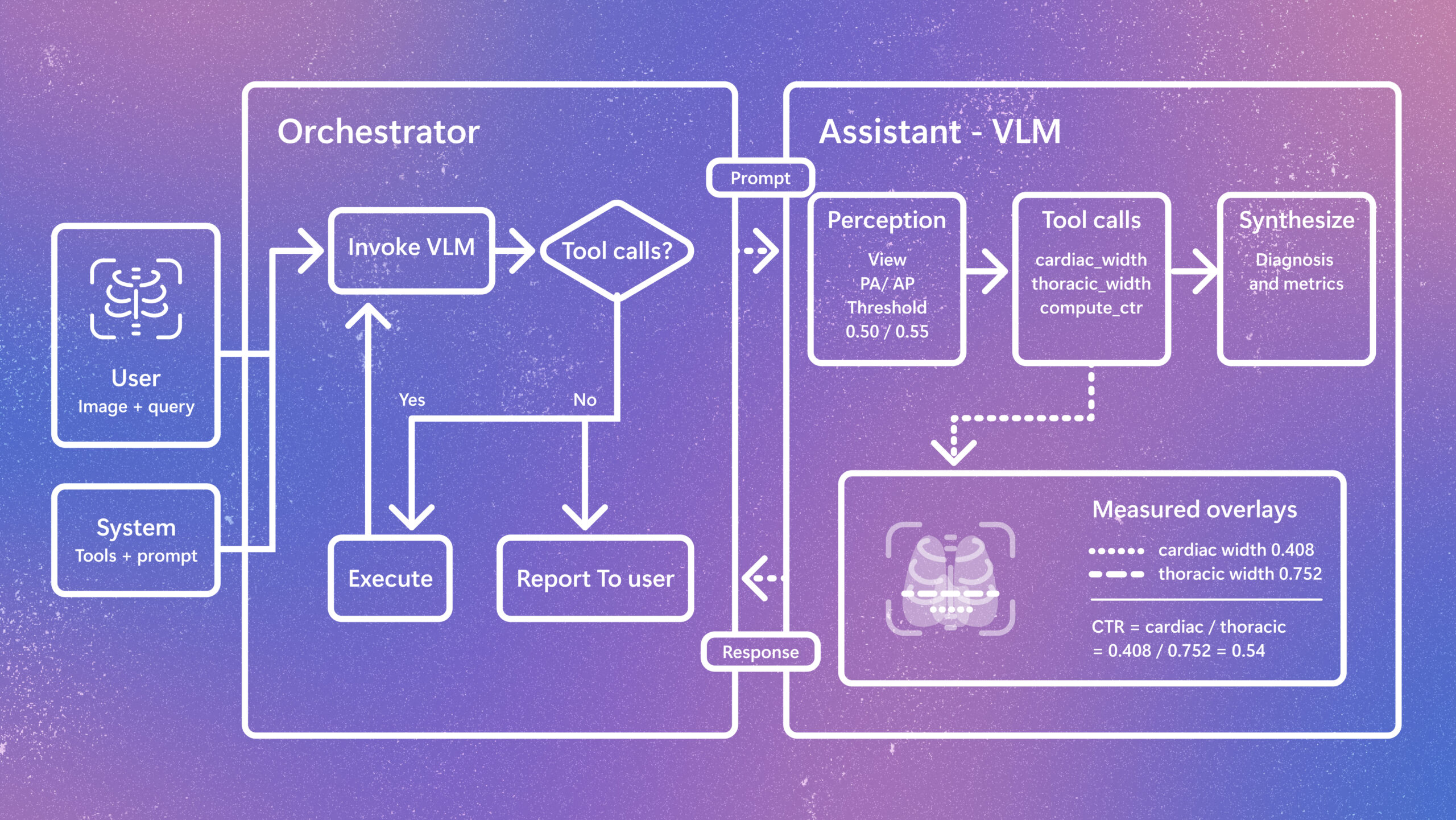
Perhaps most critically, some diagnoses depend on precise measurement rather than visual pattern recognition. Cardiomegaly, for instance, requires measuring the cardiac and thoracic widths and calculating their ratio—tasks that should be computed exactly rather than estimated by eye, especially accounting for factors like patient positioning and X-ray angle.
How CARE-X works#
CARE-X combines three key innovations. First, it uses dual inference: a single forward pass produces both free-text output and structured predictions with calibrated confidence scores. This gives clinicians the flexibility of open-ended generation alongside threshold-adjustable outputs for tasks where controlling operating points matters.
Second, the model incorporates task-specific auxiliary heads for classification and spatial grounding that are co-trained alongside the language generation objective. This means structured supervision enriches the shared representations, improving generative performance across all tasks while also delivering calibrated predictions.
Third, CARE-X uses reinforcement learning (specifically DAPO) tuned to reward clinical correctness rather than token-level accuracy, ensuring the model optimizes for what actually matters in patient care.