AI
Google's WeatherNext 3 AI model outperforms forecasting rivals—and it's coming to Search and Maps
The tech giant's upgraded weather AI beats traditional meteorological services and competing AI systems, delivering hyper-local predictions that will soon power Google's consumer products.

TechCrunch — AI
Google DeepMind and Google Research have unveiled WeatherNext 3, an AI-powered weather forecasting system that demonstrates sharper atmospheric perception and faster prediction cycles than its predecessors. The model will soon feed forecasts into Google Search, Google Maps, and Gemini, while also becoming accessible via Google's cloud services for researchers and enterprise users.
Superior accuracy across the board#
WeatherNext 3 has already established itself as the most accurate forecasting tool in testing conducted on Operational WeatherBench, a benchmark maintained by startup Brightband that compares AI forecasts. It outperforms competing deep-learning systems from Microsoft, Nvidia, and Google's own earlier iterations—as well as beating traditional physics-based forecasts generated by the U.S. National Weather Service and Europe's meteorological center.
The model measures performance across core variables including temperature, wind speed, and humidity. According to Samier Merchant, a senior staff engineer at Google, this marks a milestone: "This is going to be the first time that some of the core variables feed and power a lot of the Google products."
Three major technical leaps#
AI weather forecasting models have historically struggled with spatial resolution, rainfall prediction, and frequency of updates. WeatherNext 3 addresses each:
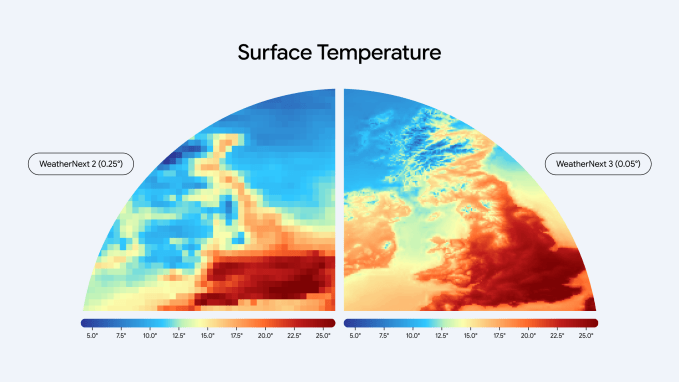
- Resolution: It can forecast down to 5 kilometers on key variables—tighter than the 15–25 km typical of competing AI systems.
- Rain forecasting: A 60% improvement over WeatherNext 2 in predicting precipitation patterns.
- Update frequency: Hourly forecasts replace the standard six-hour intervals, made possible by ingesting satellite data in real time.
How the architecture makes the difference#
The model itself is 2.4 times larger than its predecessor in terms of trainable parameters. Engineers also refined the decoder heads—the network layers that generate outputs—to produce more actionable results. Rather than reporting data averaged across a 3D grid, the system now targets predictions to specific weather stations, enabling both finer-grained forecasts and clearer validation against ground-truth measurements.

