AI
Machine Learning System Predicts Space-Weather Threats to Power Grids 30-60 Minutes in Advance
Researchers at Microsoft have built an AI pipeline that forecasts geomagnetic storm risks across tens of thousands of US electrical substations with granular, location-specific precision.

Microsoft Research Blog
During the intense geomagnetic storm in May 2024, North American power utilities faced an urgent question: where and when would solar activity damage their infrastructure? A new machine-learning system developed at Microsoft Research offers an answer—providing grid operators with location-specific warnings 30 to 60 minutes before dangerous geomagnetically induced currents threaten electrical equipment.
How space weather threatens power systems#
Extreme solar activity sends charged particles toward Earth, warping the planet's magnetic field and inducing strong electrical currents in transmission lines and transformers. These geomagnetically induced currents (GICs) can damage or disable critical equipment, forcing utilities to take protective actions or face blackouts. The challenge extends beyond simply detecting an approaching storm: operators need precise, localized forecasts with enough lead time to make decisions.
A three-stage forecasting architecture#
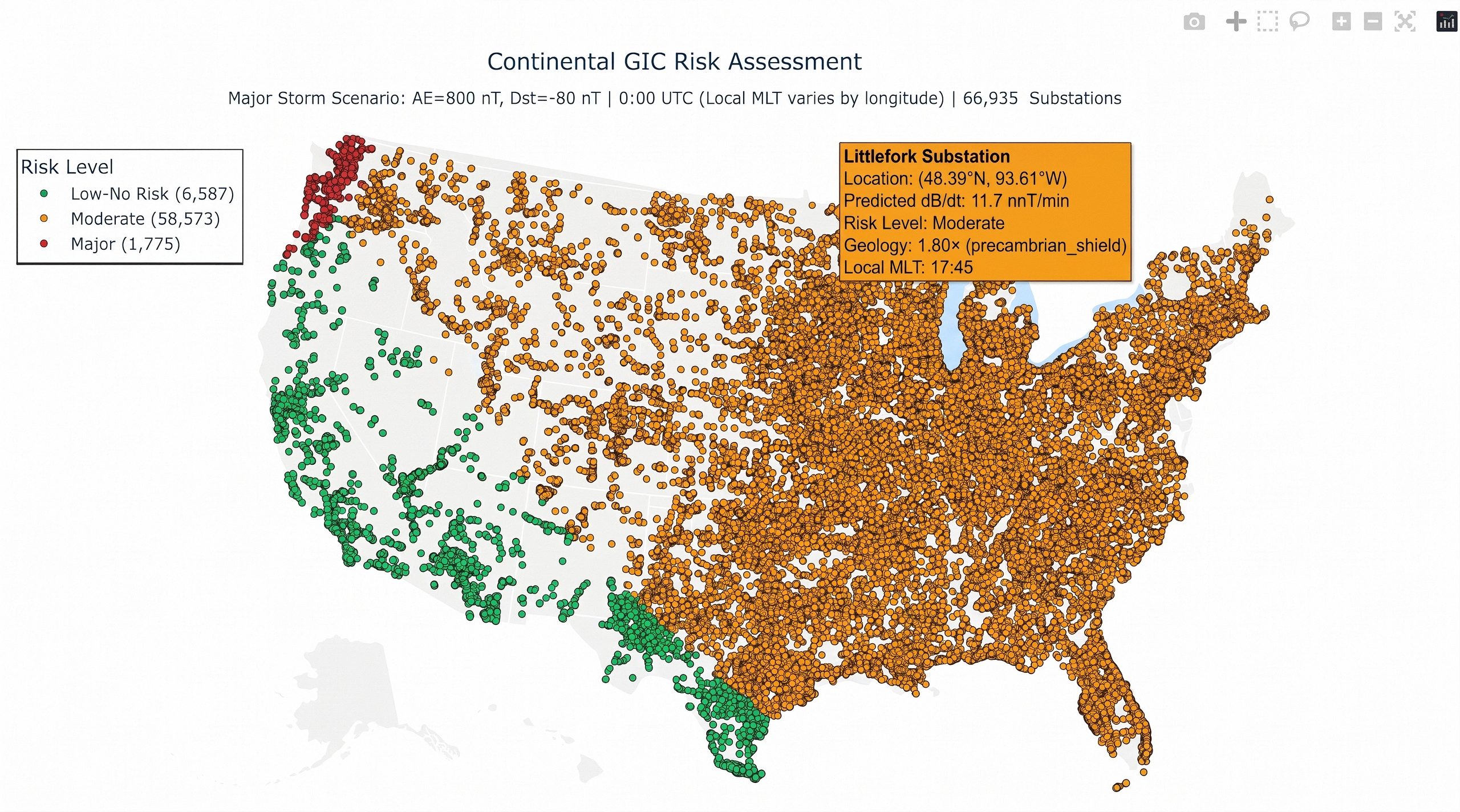
The system combines multiple information streams to estimate risk across all 66,935 electrical substations in the continental United States. The approach unfolds in three phases:
- Solar-wind forecasting: Raw solar-wind observations from the L1 Lagrange point feed into machine-learning models that predict the Auroral Electrojet (AE) and Disturbance Storm Time (Dst) indices—key measures of geomagnetic activity.
- Magnetic-field risk estimation: A gradient-boosting model merges these geomagnetic forecasts with location-specific geology and substation characteristics to calculate dB/dt, the rate of magnetic-field change that drives GIC risk.
- Continental risk mapping: Location-specific estimates aggregate into a continent-scale risk assessment, distinguishing high-risk areas (where resistive bedrock amplifies ground effects) from lower-risk zones.
The entire pipeline processes results in roughly 333 milliseconds, enabling rapid scenario evaluation.
Performance and detection rates#
Evaluated against data from 2020 to 2026, the system achieved detection rates of 76.5% for major storms, 81.2% for severe storms, and 64.1% for extreme events. The AE predictor outperformed traditional solar-wind-based empirical methods across the full range of geomagnetic activity, while the Dst component improved overall severe-event detection by 1.2 percentage points. Performance varied by latitude, with stronger detection at northern stations where geomagnetic effects naturally intensify.