AI
Nvidia executive to explore robotics' missing breakthrough moment at Disrupt 2026
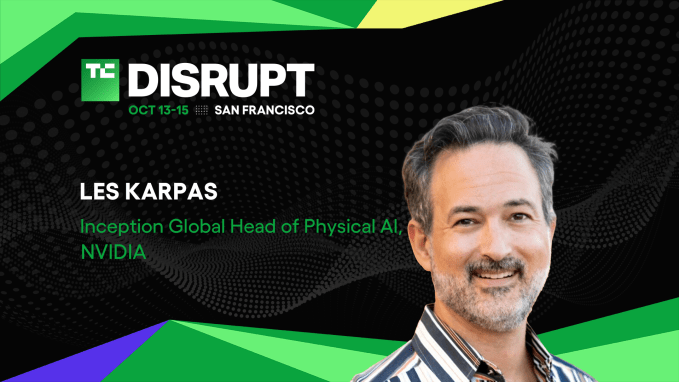
Les Karpas, head of physical AI at Nvidia Inception, will examine why the robotics industry has yet to experience its ChatGPT-like inflection point.

TechCrunch — AI
ChatGPT's arrival in late 2022 transformed artificial intelligence from speculative technology into an everyday tool almost overnight. By contrast, robotics—despite decades of development and real-world deployment—still awaits its defining breakthrough that could reshape the field.
At TechCrunch Disrupt 2026, Les Karpas, Global Head of Physical AI at Nvidia Inception, will tackle this gap. His Real World AI Stage session will explore both the obstacles holding robotics back and the possibilities for acceleration.
The data bottleneck blocking progress#
The core problem stunting robotics' growth is surprisingly straightforward to articulate but formidably difficult to solve: the field lacks a unified, internet-scale dataset comparable to the training data that powered ChatGPT and subsequent large language models. While companies like OpenAI and Anthropic leveraged vast text repositories, roboticists have no equivalent commons of physical interaction data.
Even autonomous vehicle fleets—arguably robotics' greatest success story—required years of accumulated road data to mature. Waymo and competitors built their datasets incrementally, market by market, and continue expanding them at considerable cost.
Recognizing this challenge, a wave of startups is now attempting to artificially bootstrap that scale through simulation, synthetic data generation, and foundation models trained across diverse robot architectures. The problem of translating digital learning into physical performance remains the field's central tension.
Karpas brings deep industry expertise#
Karpas is uniquely positioned to dissect these challenges. As Nvidia's point person for the physical AI startup ecosystem, he maintains direct relationships with hundreds of companies spanning robotics, autonomous vehicles, manufacturing, mobility, and smart cities—many of them racing to close the data gap themselves.
His background spans multiple disciplines: he has worked as an architect, manufacturing engineer, startup founder, venture studio leader, and corporate venture investor at firms including Stanley Black & Decker, Intellectual Ventures, Herman Miller, iRobot, and Cirque du Soleil. That cross-sector experience mirrors the versatility the robotics industry demands from its leaders.