Science
Fruit flies navigate odor plumes with neural sophistication, study reveals
Researchers discover that flies use far more advanced strategies than simple reflexes to track invisible scent trails to food and mates.

Ars Technica
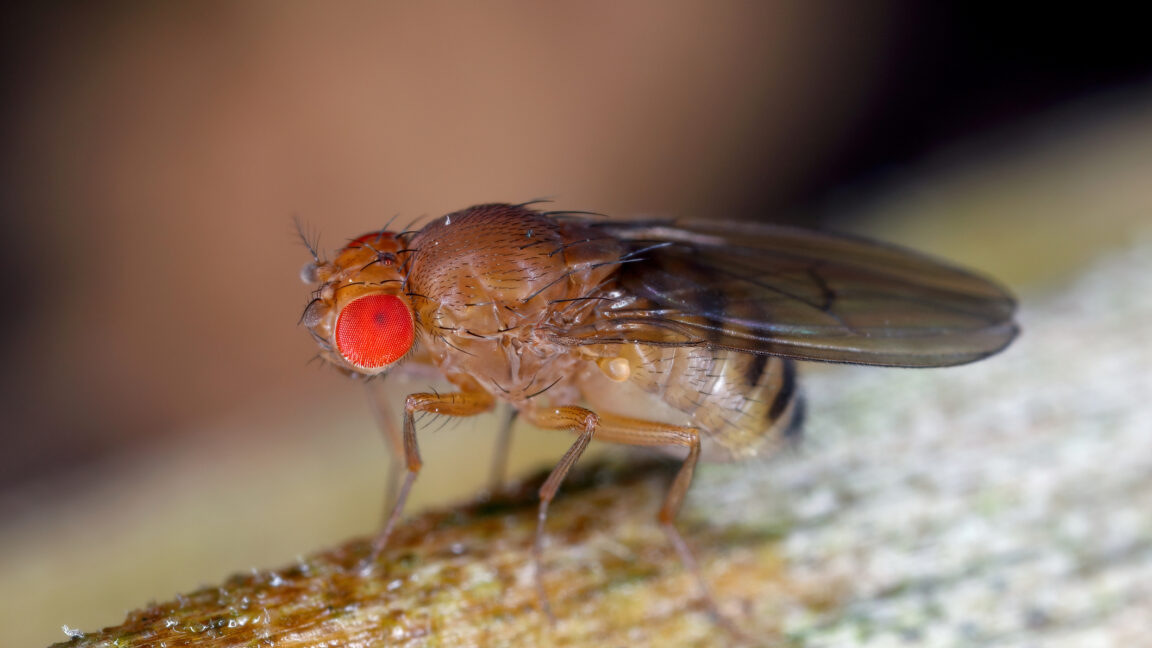
Fruit flies hunting for decaying fruit or searching for a mate rely on their sense of smell to navigate—tracking invisible plumes of odor that drift through the air. In nature, turbulent winds fragment these scent trails into scattered chemical ribbons interspersed with gaps of clean air, creating a fragmented and unpredictable sensory landscape that any insect must somehow interpret.
For decades, scientists puzzled over how such tiny creatures with brains smaller than a pinhead could manage this formidable task. The prevailing theory attributed their success to simple hardwired reflexes that required no sophisticated neural processing.
Beyond the reflex model#
The traditional explanation, known as the "surge and cast" model, suggested insects relied on basic trigger-response behavior: when olfactory receptors on the antennae detect an odor plume, the fly flies upwind; when the scent disappears, it zigzags side to side trying to relocate the trail. This straightforward mechanism seemed plausible in theory but struggled to account for how insects successfully track winding plumes across significant distances in environments where chemical signals remain sparse and unreliable.
A research team headed by Vanessa Ruta, a neuroscientist at Rockefeller University, has now demonstrated that fruit flies employ strategies far more sophisticated than these reflexive behaviors. Their findings suggest the insects possess more complex neural computations for odor navigation than previously assumed.
Designing a fly-scale experiment#
The challenge for researchers lay in the invisible nature of odor itself. As Ruta notes, scent molecules drift unpredictably with turbulent airflow, making it nearly impossible for scientists to know exactly what an animal is detecting moment to moment. To overcome this obstacle, her team engineered a clever experimental setup: a tethered fruit fly (Drosophila) was positioned atop a small air-floating ball in complete darkness—essentially a treadmill scaled for insects. As the fly walked and turned on the ball's surface, its movements steered a nozzle that continuously directed a steady airstream toward its antennae. The setup mimicked the sensation of flying freely through an open landscape with consistent wind direction.
Researchers then released apple cider vinegar into that airstream, turning the odor cue on and off based on the fly's position within this virtual environment. This allowed scientists to precisely control what the fly sensed and observe how it responded.