AI
Microsoft releases efficient pathology AI models to scale up cancer research
New streamlined versions of GigaPath and GigaTIME make large-scale tissue analysis affordable by reducing computational demands while maintaining accuracy.

Microsoft Research Blog
Microsoft Research has unveiled more efficient versions of its pathology foundation models, designed to make large-scale tissue analysis accessible to researchers working with large patient cohorts. The new GigaPath-Flash and GigaTIME-Flash models retain the analytical power of their predecessors while dramatically cutting the computing resources needed.
Computational barriers to pathology research#
Histology slides contain rich biological information at subcellular detail, and hospitals generate millions annually. Yet applying AI models to these images poses a scaling problem. Individual slides often exceed a gigapixel in size, requiring processing of thousands of image tiles each. When researchers want to study tens of thousands of patients across multiple experiments, the computational bill becomes prohibitive. This cost ceiling effectively limits how many patients, datasets, and scientific hypotheses researchers can explore.
A new generation of compact models#
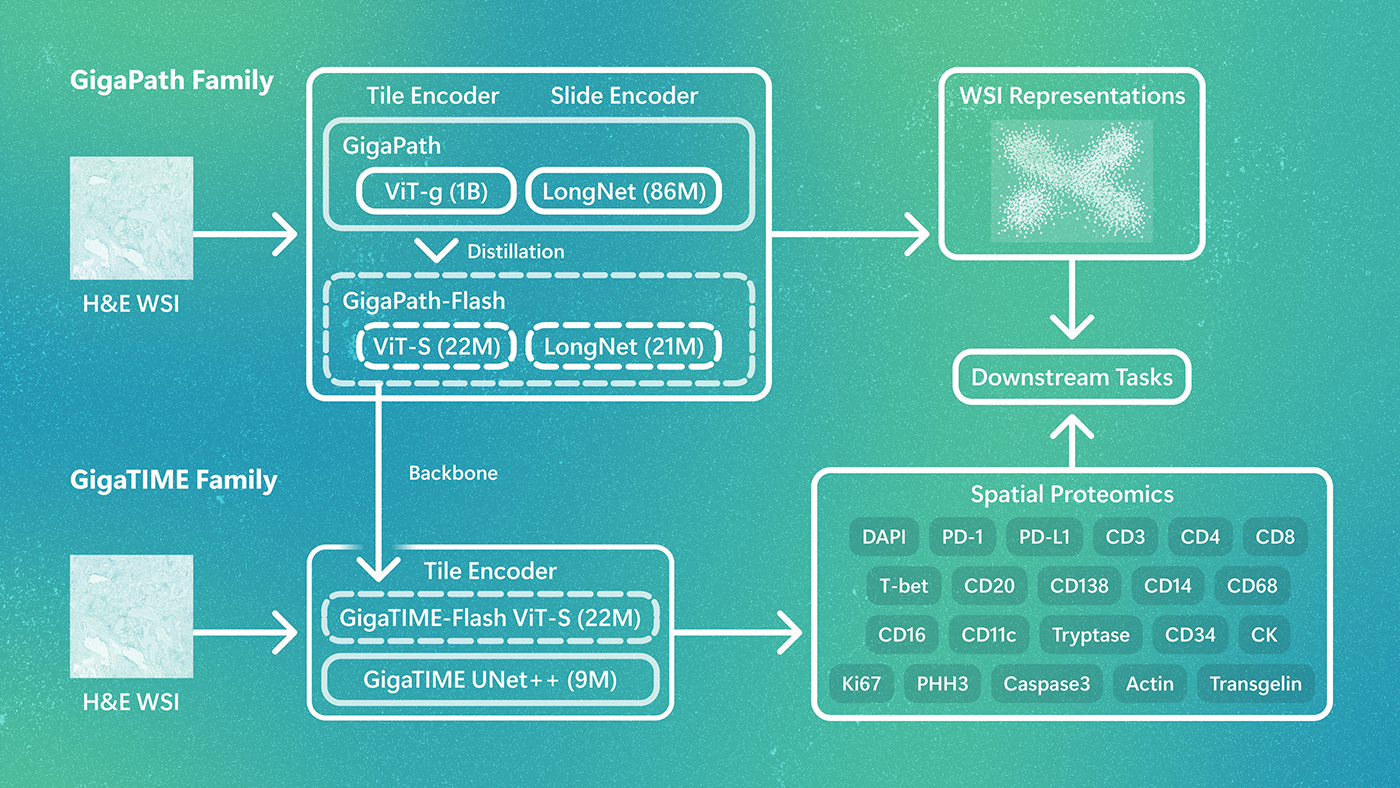
The original GigaPath and GigaTIME models demonstrated the potential of foundation models trained on real-world pathology data. GigaPath learns context-aware representations of entire slides by capturing both fine-grained cellular patterns and larger tissue structures. GigaTIME extends this approach to tumor environments, using routine H&E stain images to generate virtual maps of 21 different proteins—a technique validated across over 14,000 cancer patients.
The Flash family addresses the practical obstacle: computational expense. At its core sits a compact ViT-S tile encoder derived from the original billion-parameter GigaPath model, distilling its representational capacity into a backbone one-tenth the size.
GigaPath-Flash#
GigaPath-Flash combines a 22-million-parameter tile encoder with a 21-million-parameter LongNet slide encoder that uses dilated attention to contextualize all tile embeddings while scaling linearly. On benchmark tasks for prostate and brain tumor grading, it performs within 3% of the original GigaPath while requiring roughly 50 times less computational power.

